
 If you want total strength and durability in demanding conditions, choose ASA or ABS.
For a balance between ease of use and good strength, go for PETG.
PLA Tough and PLA PRO outperform standard PLA, but they are geared more towards precision or occasional strength rather than sustained loads.
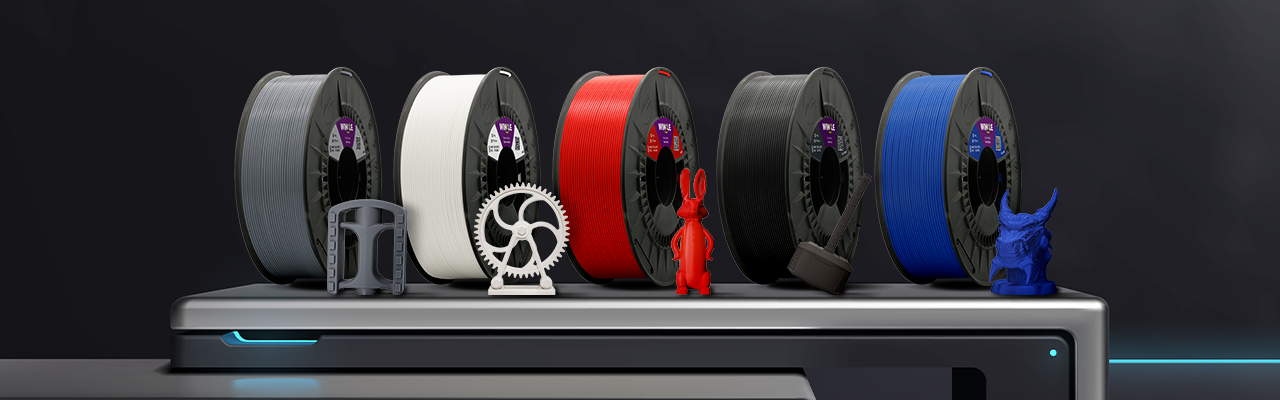
Among our strongest 3D filaments are PLA Tough, ABS, ASA, PETG and PLA PRO.
- ASA, or Acrylonitrile Styrene Acrylate: very high durability. It resists impact, the elements, UV rays and high temperatures. Ideal for outdoor and long-term functional parts.
- ABS, or Acrylonitrile Butadiene Styrene: high mechanical and thermal resistance. Although less UV resistant than ASA, it is very durable in industrial settings. It requires an enclosed printer.
- PETG or Polyethylene Terephthalate Glycol: a balance between strength and ease of printing. It withstands moderate mechanical stress, is water resistant and slightly flexible. Less rigid than ABS/ASA, but more dimensionally stable.
- PLA Tough: it offers impact resistance and strength twice that of ABS, with the ease of printing and rigidity of PLA.
- PLA PRO: an advanced filament designed for industrial applications that require high printing speeds (over 120 mm/s) alongside superior thermal and mechanical properties. It allows high productivity and withstands temperatures above 95 °C after annealing.
In this post we take a detailed look at the characteristics of each of these materials, their properties and applications. Want to know which is the strongest 3D filament?  Read on!
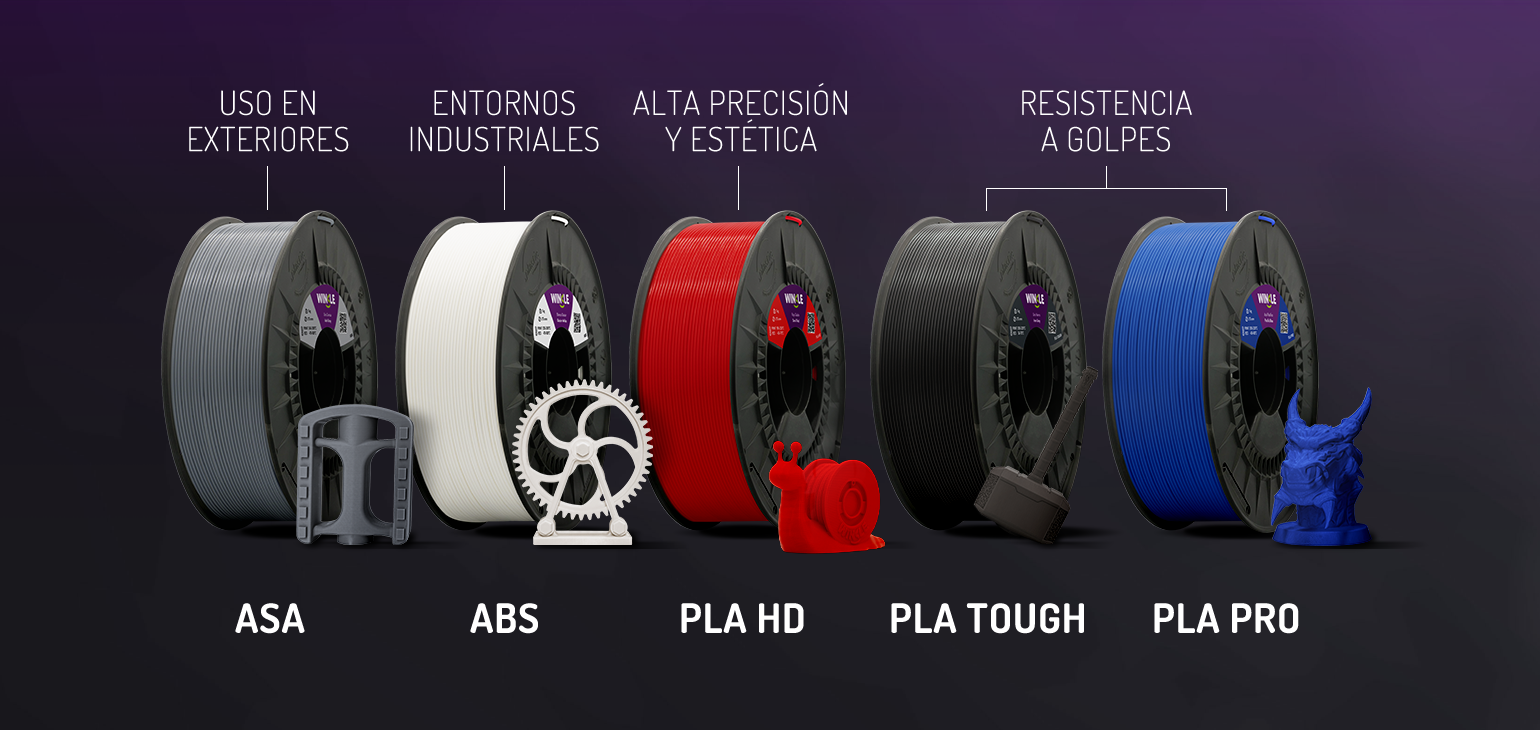
Winkle’s strongest filaments for 3D printing
These filaments are designed to withstand demanding conditions such as high temperatures or heavy impacts.
Which filament should you choose? It depends on your project.
| Application | Recommended filament |
| Impact-resistant parts | PLA Tough, PLA PRO |
| Outdoor use | ASA |
| Industrial or technical settings | ABS, PETG CF |
| High precision and appearance | PLA HD |
Which is the strongest filament for 3D printing?
The answer to this question varies depending on the type of strength you are after.
It is clear that for mechanical strength and impact PLA Tough is without doubt the best option.
However, for resistance to high temperatures or chemicals, ABS and ASA filaments are preferable.
If you need weather resistance, ASA is without doubt the one to choose.
Differences in printing temperatures
It is worth stressing that the printing process is key to getting the best out of the filaments. Following the manufacturer’s recommendations to improve your 3D prints can save you problems such as deformation or cracks.
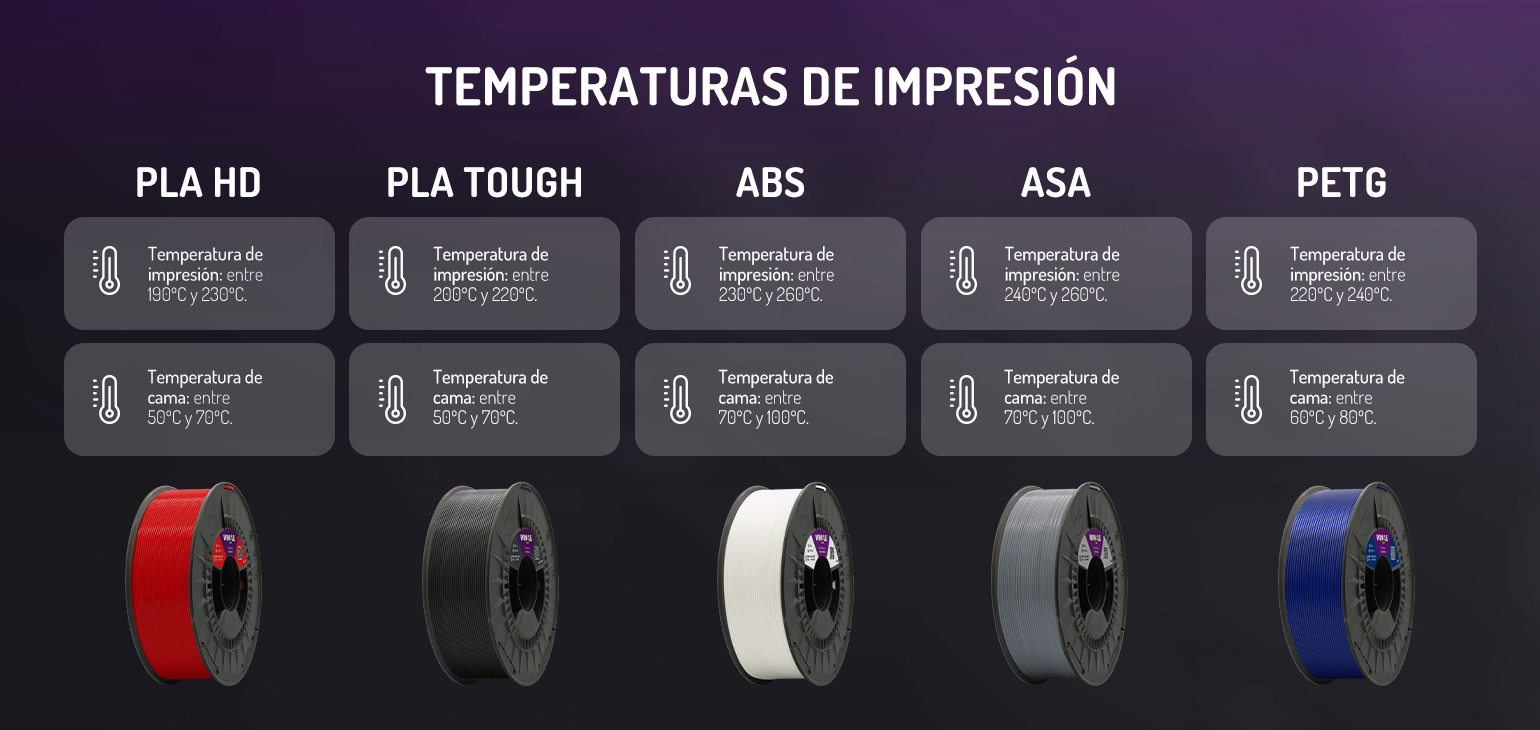
- PLA Tough: between 200-220 °C, heated bed optional (50-70 °C). Its ease of printing makes it ideal for beginners and advanced users alike.
- ABS: 230-260 °C, heated bed required (70-100 °C). Printing ABS calls for a well-calibrated printer and a controlled, ventilated environment to avoid deformation and unpleasant smells. An enclosed chamber is required.
- ASA: 240-260 °C, heated bed required (70-100 °C). Similar to ABS, it needs precise conditions for a successful print. An enclosed chamber is also required.
- PETG: 220-240 °C, heated bed optional (60-80 °C). It is known for adhering easily to the bed and having a low tendency to deform.
- PLA HD: 190-230 °C, heated bed optional (50-70 °C). Similar to PLA Tough, it offers a good printing experience with high quality.
If you need more information, you can always consult our technical datasheets!
Industrial applications of 3D filaments: which material to choose for each environment?
Choosing the filament, or 3D printing thread, does not depend on strength alone. Every sector (automotive, electronics, architecture, outdoor) has different demands: exposure to impact, chemicals, moisture, UV radiation and so on.
These are the most common industrial applications of strong 3D filaments and their comparative advantages. Improve your 3D prints!
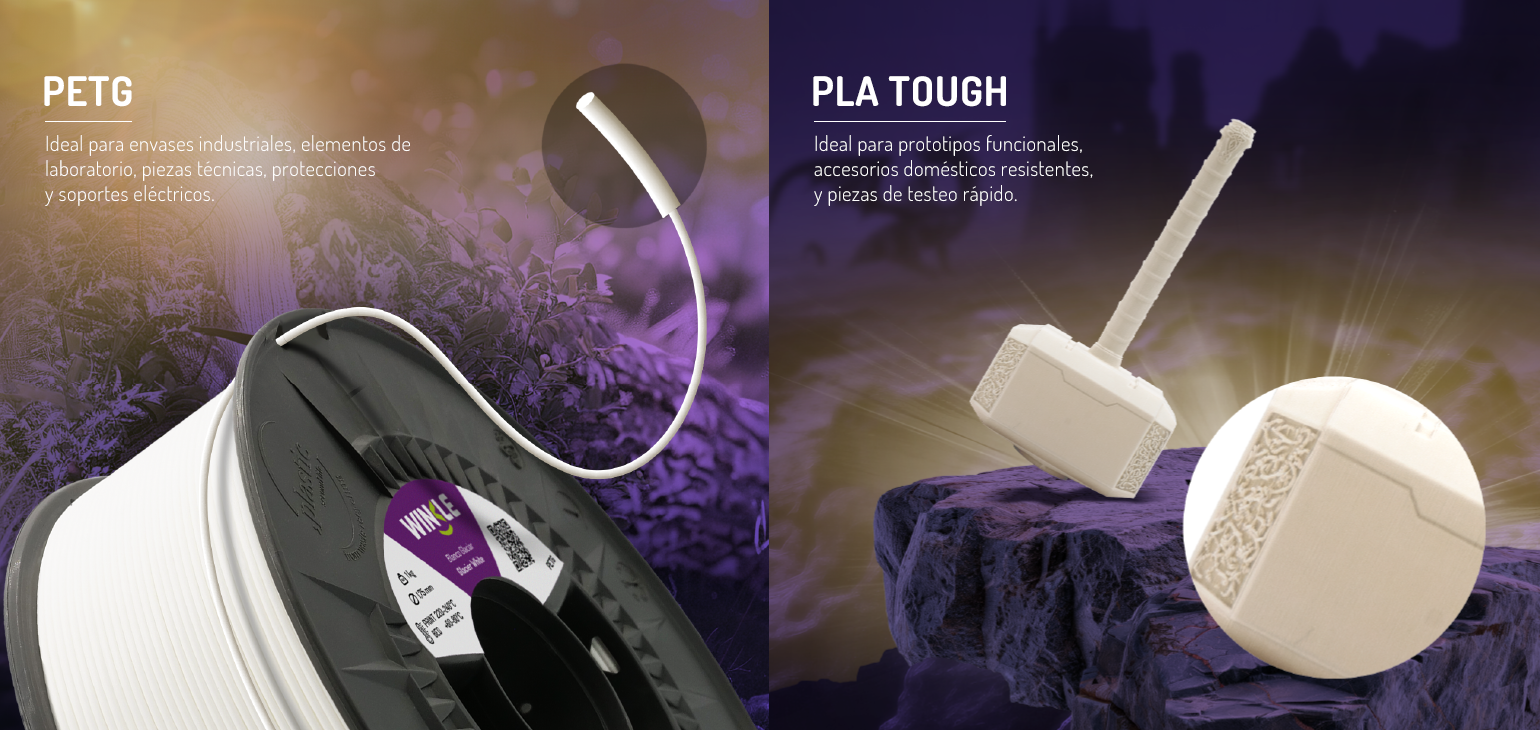
PLA Tough
Ideal for: functional prototypes, hard-wearing household accessories, rapid test parts.
✔ Why choose it: it combines the ease of printing of PLA with improved impact resistance, without needing an enclosed printer.
Example:
ABS
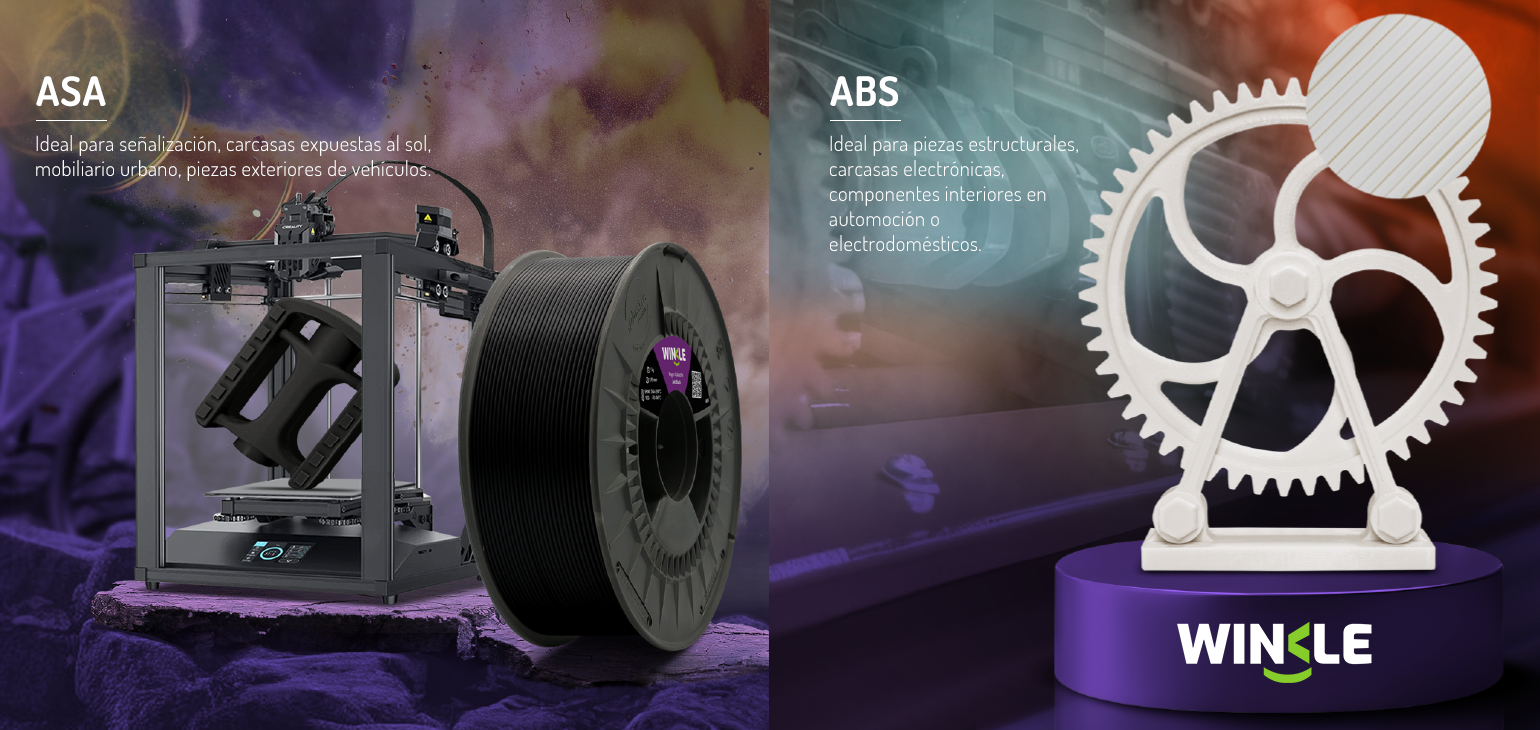
Ideal for: structural parts, electronic housings, interior components in automotive or household appliances.
✔ Why choose it: it is the industry standard for its toughness and its thermal and chemical resistance.
It requires an enclosed printer to avoid warping, but its mechanical performance more than makes up for it.
ASA
Ideal for: signage, housings exposed to the sun, street furniture, exterior vehicle parts.
✔ Why choose it: it resists UV rays, water and extreme temperatures. Designed to last outdoors without degrading or fading.
PETG
Ideal for: industrial packaging, laboratory items, technical parts, guards, electrical mounts.
✔ Why choose it: it is chemically resistant, semi-flexible and easy to print. It meets food and medical regulations when correctly formulated.
PLA HD
Ideal for: technical mounts, functional decorative pieces, lightweight structures, models and prototypes.
✔ Why choose it: it stands out for its rigidity, ease of printing and good performance in parts that do not need flexibility.
| Critical condition | Recommended filament |
|---|---|
| Sun exposure / moisture | ASA |
| High impact resistance | PLA Tough, PLA PRO |
| Chemicals / high temperatures | ABS, PETG |
| Ease of printing | PLA HD, PLA Tough |
| Food applications | PETG (suitable grade) |
So. Which is the strongest 3D filament? Don’t be left guessing! 
To finish, it is important to stress that choosing the right filament depends on the specific needs of your project. At Winkle, we work hard to offer a range of filaments covering a variety of industrial, functional and decorative applications.
From hard-wearing ABS to long-lasting ASA, every 3D filament has its own unique advantages. By understanding the properties of each filament, you can make informed decisions and optimise your 3D printing processes.


