The most common problems in 3D printing, how to identify them and how to fix them: warping, delamination (cracking) and Z wobble.
As you already know, failures in 3D printing do not appear by chance. Every defect in a part has a specific cause: thermal, mechanical or material-related.
Understanding this is key: not every problem is solved by adjusting the same thing on the printer.
At Winkle we set out to identify and solve, drawing on our technicians’ experience, the three most frequent problems when using a 3D printer.
Warping, delamination (cracking) and Z Wobble, explaining why they happen, how to spot them and how to fix them properly.
Why do these 3D printing problems occur? Where do they come from?
There are many reasons why our prototypes can go wrong: excessive temperature, poor levelling, a jammed extruder, warping problems and so on.
It is not about “trying things”, but about understanding what is happening to your part. If you control temperature, adhesion and mechanics, you control the result.
And if you also work with a reliable filament, like Winkle’s, you eliminate a large share of the errors from the outset.
 How to tell which problem you have. Diagnosing it correctly is 80% of the solution.
- It comes away from the build plate → warping.
- Layers separate → delamination.
- Repeating waves → Z Wobble.
Warping
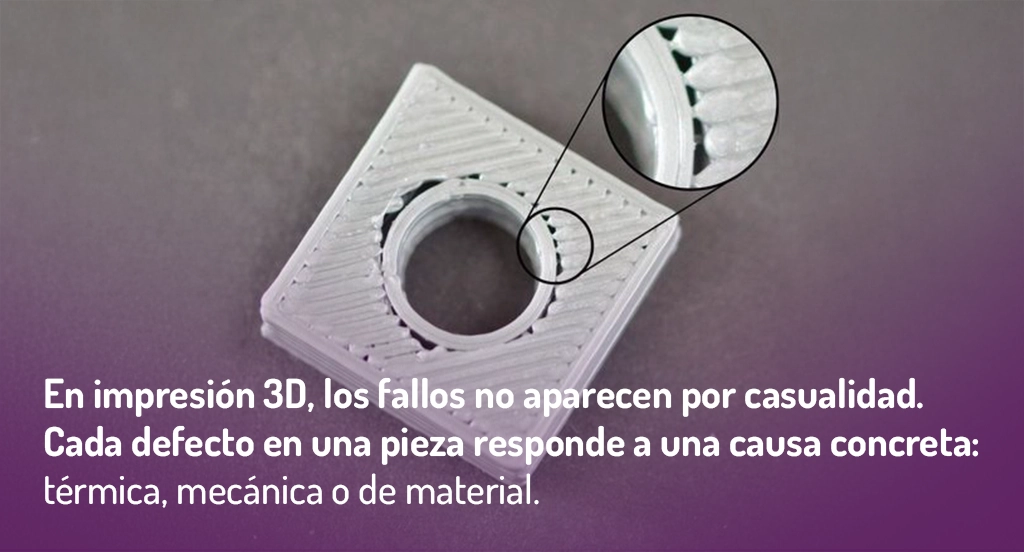
Warping is a deformation at the base of the part caused by uneven thermal contraction.
You notice it because the corners lift, the edges curl and adhesion to the build plate is lost.
Warping happens because the material cools and contracts.
If the base is colder than the upper layers, stresses build up that lift the part.
It is not a printer problem, it is a problem of thermal balance + adhesion.
Warping tends to occur with large parts, filaments such as ABS or cold environments.
How do you fix warping?
- Always use a heated bed, even with filaments that do not need it such as PLA (≈60 ºC).
- It is essential that the printer is well calibrated: a level surface and the extruder at the right distance.
- In the slicer, set an adhesion surface, such as a “raft”, to optimise adhesion.
- Use covers for 3D printers to stabilise the temperature inside. This improves not only the adhesion of the part but also the quality when printing complex elements.
- Apply a quality adhesive that helps keep the part firmly stuck to the heated bed.
Cracking
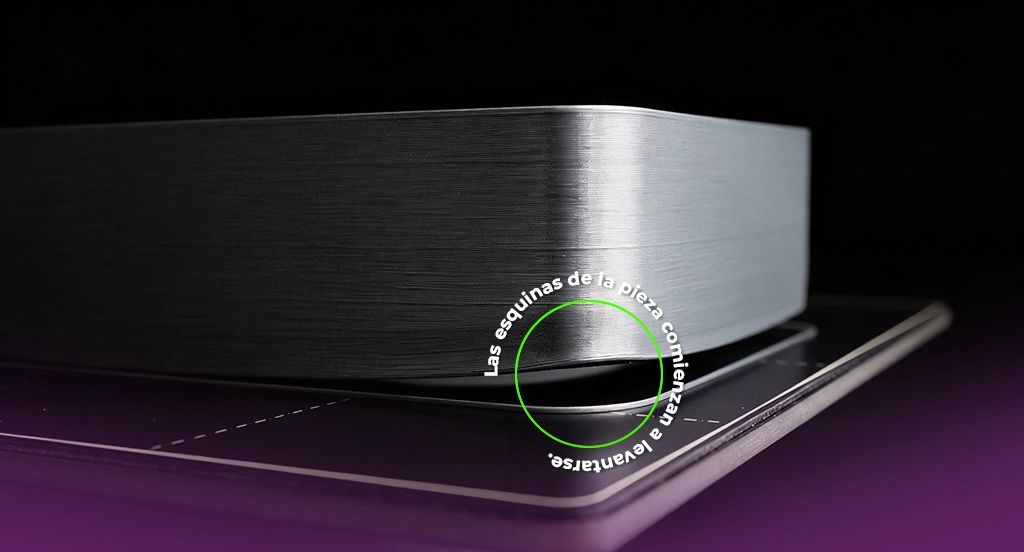
Delamination is the separation between layers due to a lack of fusion between them.
This type of print failure shows up as horizontal cracks in the material, layers that open up and parts that are brittle.
The main cause of delamination is that the layers do not fuse properly.
The temperature is insufficient, cooling is excessive and there is moisture in the filament. This print failure tends to occur with technical filaments such as ABS or ASA, tall parts or unstable environments.
It is a problem of thermal energy between layers, and it has a solution:
- Raise the printing temperature.
- Reduce cooling.
- Avoid draughts.
- Dry the filament.
- Use an enclosure with ABS/ASA.
- Adjust the printing speed.

Z Wobble
Z Wobble is a mechanical defect that produces repeating waves along the Z axis.
You notice it because periodic lines appear up the height of the part, surfaces are wavy and there is a repeating pattern. This 3D printing failure misaligns the lead screw, the threaded rod and the belts.
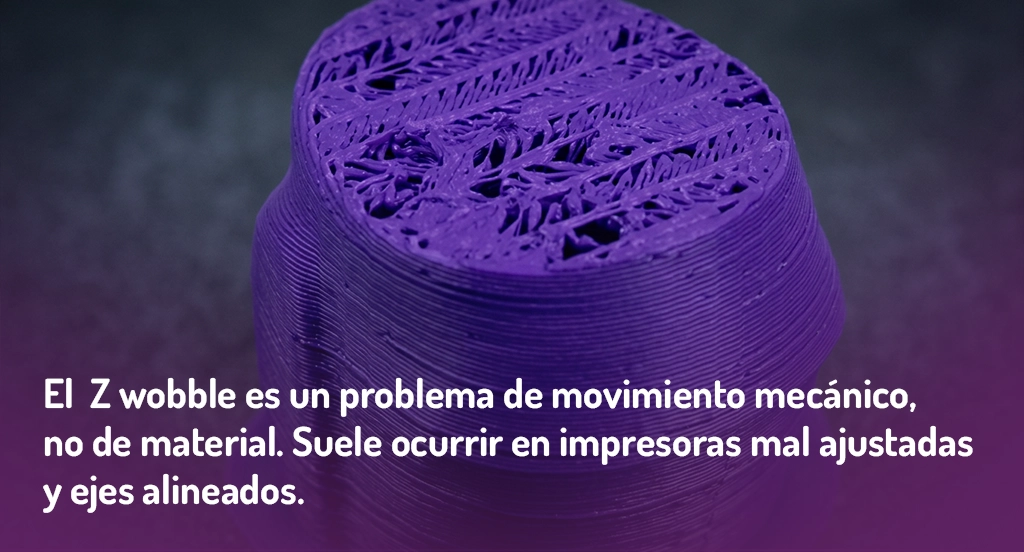
Z Wobble is a problem of mechanical movement, not of material. It usually occurs on poorly adjusted printers and misaligned axes.
How do you fix Z wobble?
- Check the alignment of the lead screw.
- Adjust the belt tension.
- Check the couplings.
- Inspect the printer’s frame.
- Reduce vibration.
Why use Winkle filament
At Winkle we work to remove that source of error from the outset:
✔ Precise dimensional tolerance.
✔ Stable, homogeneous material.
✔ Moisture control during manufacture.
✔ Constant flow for better layer adhesion.
This translates into:
- fewer print failures,
- better surface quality,
- stronger parts,
- repeatable results.
If you have already tuned your printer but still have problems, the filament is probably the factor holding you back. Working with a reliable filament saves you time, material and frustration.
There are other common problems such as stringing or under-extrusion; here is how to fix them.