

🔥FREE shipping on orders of €80 or more ¡Buy Now!





 0
0
 There are no items in your cart
Browse our store and discover our product catalog.
Continue shopping
There are no items in your cart
Browse our store and discover our product catalog.
Continue shopping
3D resins are designed for maximum precision, detail, and surface finish. Ideal for jewelry, dentistry, engineering, miniatures, and high-definition prototypes. They allow for complex geometries and very tight tolerances. If your priority is professional detail, visual quality, and extreme precision, resin is the ultimate material.
 Deliveries in 48/72 hours
 Guaranteed quality
 FREE Shipping
  100% Secure payments


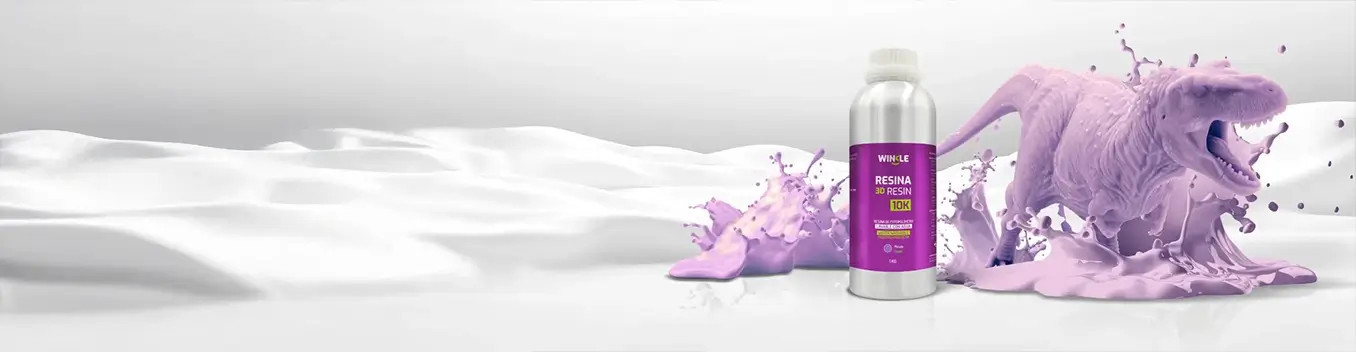
3D resin is a liquid photopolymer material specifically designed for resin-based 3D printing technologies such as LCD, DLP, and SLA printers. When exposed to UV light, the resin undergoes a chemical reaction that transforms it from a liquid into a solid material, allowing the printer to build objects layer by layer.
This curing process enables extremely fine details and high resolution in printed parts. Resin printing technology can produce models with smoother surfaces and more precise textures than many filament-based printing methods.
Because of these characteristics, resin printing is widely used for projects that require precision and high visual quality.
The general workflow of resin printing includes several steps:
This method allows the creation of highly detailed pieces with very thin layers, resulting in professional-level finishes and accurate geometries.
Additive manufacturing technologies like resin printing create objects by building them layer by layer from a digital 3D model, which enables the production of complex shapes and customized designs.
This makes resin printing ideal for applications such as:
Smooth surface finish
Resin prints typically have smoother surfaces than filament prints. Because each layer is very thin, visible layer lines are greatly reduced.
This reduces the need for sanding or additional finishing, especially when creating decorative or presentation models.
Strong and durable parts
Many modern resins are formulated to provide strong and durable prints. Some materials offer resistance to impacts, abrasion, and temperature changes, allowing printed objects to be used for functional parts as well as visual models.
These characteristics make resin suitable for both prototypes and final-use components.
Easy post-processing with water-washable resins
Some advanced resins are designed to simplify post-processing. For example, water-washable resins allow prints to be cleaned with water instead of isopropyl alcohol, making the cleaning process faster and safer.
This type of resin also reduces the environmental impact of printing and improves the user experience during post-processing.
There are many different types of resin materials available for 3D printing. Each type is designed for specific applications and mechanical requirements.
Common types of 3D resin include:
Thanks to its precision and material versatility, resin printing is used across many industries.
Prototyping and product development
Designers and engineers frequently use resin printers to create prototypes during product development. The high accuracy allows them to evaluate design details before manufacturing.
Miniatures and collectibles
Resin printing is extremely popular in the tabletop gaming and collectible industries. The technology can reproduce very small details, making it perfect for miniatures and figurines.
Dental and medical models
In dentistry and medical applications, resin printers are used to create highly accurate models for planning treatments and manufacturing dental components.
Functional parts
Certain resin materials offer excellent mechanical properties, allowing the production of functional parts such as housings, connectors, and mechanical components.
Decorative and artistic objects
Artists and designers often use resin printers to create sculptures, jewelry, and decorative models because of the smooth surfaces and detailed textures the technology provides.