


- New
🔥FREE shipping on orders of €80 or more ¡Buy Now!


 0
 There are no items in your cart
Browse our store and discover our product catalog.
Continue shopping





 Deliveries in 48/72 hours
 Guaranteed quality
 FREE Shipping
 100% Secure payments


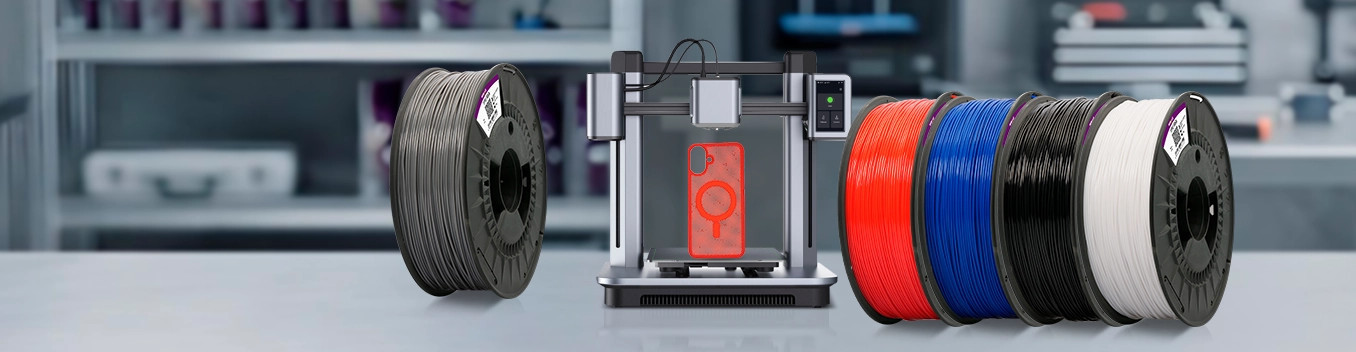
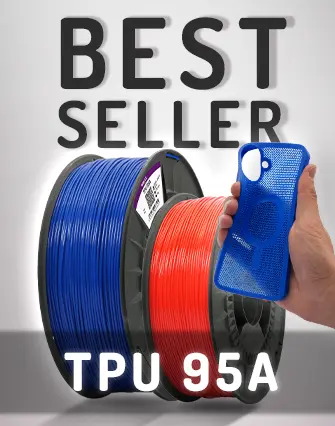
Winkle TPU 95A is a 1.75 mm thermoplastic polyurethane filament, manufactured in Spain, for parts that need to flex without losing body: they bend, withstand abrasion and impacts, and return to their shape. It prints with the bed at 35 °C and is available in white, black, red, grey and blue, on 1 kg spools.
| Property | Value |
|---|---|
| Material | Thermoplastic polyurethane (TPU) |
| Hardness | Shore 95A |
| Diameter | 1.75 mm |
| Spool | 1 kg |
| Colors | White, black, red, grey and blue |
| Nozzle temperature | 220–235 °C |
| Bed temperature | 35 °C |
| Print speed | 20–40 mm/s (guideline) |
| Made in | Salamanca, Spain |
A TPU 95A part bends by hand and springs back to its shape when released, but it doesn’t sink under the pressure of a finger. With thin walls it works like a flexible sheet; with more thickness it gains body and acts as a block or a stop.
With the same TPU 95A you can change how the part feels without switching filament: infill and walls determine how much it gives.
| Setting | Softer part | Firmer part |
|---|---|---|
| Infill | Low, 10–20% | High, 50–100% |
| Walls (perimeters) | 1–2 | 3 or more |
| Infill pattern | Gyroid, which gives evenly in all directions | Dense grid or rectilinear |
| Part thickness | Thin | Thick |
Guideline values: print a test part before the final one.
Black
Technical parts and spares that should go unnoticed.
White and grey
Neutral finishes for end products, housings and accessories.
Red and blue
Identification at a glance: seals of different sizes, parts from the same kit, or elements that need to be visible.
| Symptom | Likely cause | Solution |
|---|---|---|
| Fine strings between parts of the print | Wet filament or nozzle too hot | Dry the spool and lower the temperature within the 220–235 °C range |
| Filament buckles or jams in the extruder | Excessive speed or gaps in the filament path | Go back to 20–40 mm/s and check the guide between the gear and the nozzle |
| Layers separate when the part is bent | Low temperature or high speed | Raise the nozzle toward 235 °C and reduce speed |
| Popping sounds while printing and bubbly surface | Moisture in the filament | Dry before printing |
| First layer doesn’t stick | Wrong bed temperature or dirty surface | Bed at 35 °C and a clean surface |
| Part comes out too stiff or too soft | Infill and walls | Adjust according to the table above |
Need a different flexible? If your part needs to be as light as possible or flex constantly, like a hinge, check out PEBA PRO. To compare the full range, visit the Flexible filament category.
TPU is usually the first flexible filament a maker buys, and Winkle TPU 95A meets that demand with a single technical SKU in five colors. Manufactured in-house in Spain, on 1 kg spools, with consistent quality from batch to batch.
TPU 95A is a good choice for seals and plugs: it’s elastic enough for a press fit and firm enough not to deform during assembly. Print with very high infill and check the seal in your application.
Yes. Its resistance to wear and abrasion makes it suitable for wheels and treads, and its elasticity improves grip on the floor.
Reduce infill to 10–20%, use one or two perimeters and choose a gyroid pattern. With high infill and more walls, the same part comes out firmer.
35 °C, a low temperature that virtually any printer with a heated bed can reach. The nozzle runs at 220–235 °C.
Between 20 and 40 mm/s as a guideline. If the filament buckles or jams, lower the speed before changing other settings.
White, black, red, grey and blue, on 1 kg spools with a 1.75 mm diameter.
Most often the filament has absorbed moisture or the nozzle temperature is too high. Dry the spool and try the lower end of the 220–235 °C range.
It depends on the part. 95A is firmer and easier to print; 85A is softer but requires a direct-drive extruder and more care. For most functional parts, 95A is the place to start.
It is manufactured in Salamanca, Spain, in Winkle’s own facilities, which gives us full control over quality and consistency in every spool.