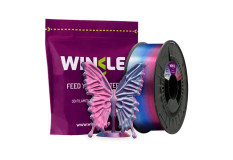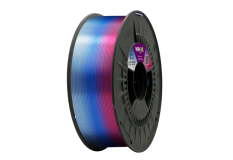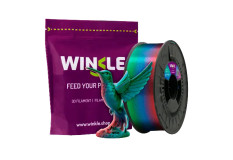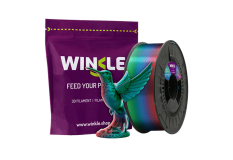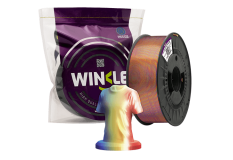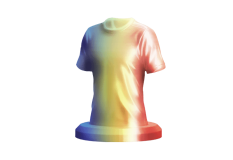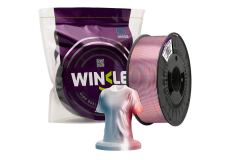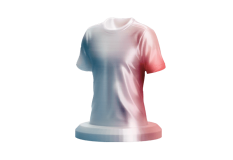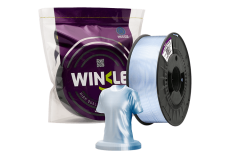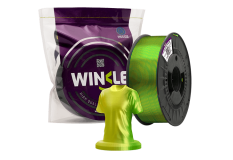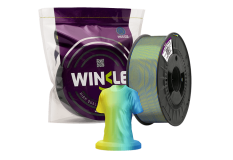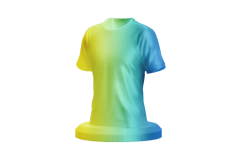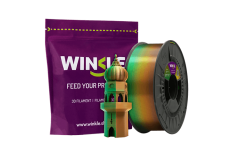
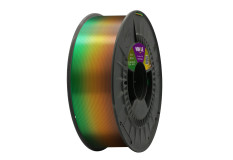
PLA Silk Multicolor Winkle Filament - DUBAI CHOCOLATE
🔥FREE shipping on orders of €80 or more ¡Buy Now!
PLA Silk Tricolor
PLA Silk Multicolor Winkle Filament - METAMORPHOSIS
PLA Silk Multicolor Winkle Filament - AURORA BOREALIS
PLA Silk Multicolor Winkle Filament - COLOMBIA
PLA Silk Multicolor Winkle Filament - FRANCIA, PAISES BAJOS, EEUU
PLA Silk Multicolor Winkle Filament - ARGENTINA
PLA Silk Multicolor Winkle Filament - Yellow-Green
PLA Silk Multicolor Winkle Filament - SUECIA, UCRANIA
PLA Silk Multicolor Winkle Filament - ALEMANIA
PLA Silk Multicolor Winkle Filament - ESPAÑA
PLA Silk Multicolor Winkle Filament - PORTUGAL, MARRUECOS
-
Deliveries in 48/72 hours
-
Guaranteed quality
-
FREE Shipping
on purchases over €80 -
100% Secure payments
-
You print a spiral vase, set it by the window, and every side shows a different colour. That is what tri-colour filament does: one spool, one nozzle, and two or three colours in the same print.
Tri-colour filament is a Silk PLA with three colours joined in the same strand; dual colour filament has two. It is made by coextrusion: the colours are extruded together, side by side, along the entire spool. As the filament is laid down, each colour faces a different side of the print, so the shade you see shifts with the viewing angle and the light, giving an iridescent effect. The silk finish adds shine and hides layer lines.
It is not the same as rainbow or gradient filament. With rainbow filament, the colour changes in sections along the spool, so the print comes out in horizontal bands by height. In tri-colour PLA and dual colour PLA, all colours run through the whole strand at once: the print is not split into bands, it shows one shade or another depending on where you look from.
Tri-Colour, Dual Colour or Single-Colour Silk PLA: Which One to Choose
All three share the same silk finish. What changes is how many colours are in the strand and how they behave on the print.
If you prefer a single shade with shine, see the full range of solid-colour silk PLA.
| Type | Colours per strand | Effect on the print | Best for |
|---|---|---|---|
| Tri-colour silk PLA | 3 | Three shades that shift with the angle. The most visible colour change. | Figures, vases and prints seen from several sides. |
| Dual colour silk PLA | 2 | Contrast between two shades, easy to read even on small prints. | Keychains, logos, medals and small parts. |
| Single-colour silk PLA | 1 | Even silk shine, no colour shift. | Batches of identical parts or fine details where colour must stay constant. |
| Rainbow or gradient | 1 that changes along the spool | Horizontal bands by print height. | Tall prints where you want a vertical transition. |
Multicolour Filament or Multicolour Printing with an AMS: What Suits You
There are two ways to get several colours in one print: use a filament that already carries them, or use several single-colour spools and a system that switches between them (AMS, MMU or similar). They don't compete: they solve different problems.
| Multicolour filament | Multicolour system (AMS, MMU) | |
|---|---|---|
| Spools | One | One per colour |
| Printer | Any 1.75 mm FDM printer with a single extruder | Requires the multicolour system |
| Filament swaps | None | One at every colour change |
| Wasted material | None from colour changes | Purge or prime tower at every change |
| Print time | Same as a single-colour print | Increases with every colour change |
| Colour control | Set by geometry and viewing angle | You decide which colour goes where |
| Result | The whole print shifts colour as it turns | Fixed colour zones with sharp edges |
Uses of Multicolour Filament
The colour shift shows best on curved surfaces and on prints seen from several angles. On a flat face viewed head-on, the effect comes down to one or two shades.
- Home decor: spiral-mode vases, lamps, planters and organisers.
- Figures and busts: faceted and spiral shapes show a different shade on every side.
- Articulated figures and print-in-place toys: articulated dragons, fish or snakes, where each segment shows a different colour as it moves.
- Trophies and medals: the silk shine gives a metallic look with no painting or sanding.
- Jewellery: lightweight earrings, pendants and brooches with a silk shine.
- Keychains and merchandise: small, quick prints with a finish that stands out in the hand.
- Personalised gifts: name plates, boxes and decorative letters.
- Board games and tabletop RPGs: dice, dice towers, tokens and card organisers.
- Cosplay and props: crowns, gems and decorative accessories that don't need to bear load.
- Seasonal decorations: Christmas baubles and stars, or event decor.
- Letters and logos for shop windows: large pieces that change colour depending on the angle the window is seen from.
- Social media content: the colour shift looks especially good on video, as the print turns.
How to Print Tri-Colour and Dual Colour Silk PLA
It prints like any standard silk PLA, on any 1.75 mm FDM printer. These are the starting settings:
| Setting | Recommended value |
|---|---|
| Material | Tri-colour or dual colour silk PLA |
| Diameter | 1.75 mm |
| Spool weight | 1 kg |
| Nozzle temperature | 200–220 °C |
| Bed temperature | 0–60 °C |
| Nozzle | 0.4 mm or larger |
| Speed | Medium, with slower outer walls |
| Finish | Silk-like shine |
Multicolour Filament FAQ
Will it work on my printer?
Yes, if it's a 1.75 mm FDM printer. It prints with a single extruder, like any PLA, with no multicolour system needed.
Can I choose which colour goes on each part of the print?
No. How the colours fall depends on the geometry and orientation of the print, not on the area. If you need an exact colour on a specific part, use single-colour spools with a multi-material system or filament changes by layer.
Is the effect visible on small prints?
Yes, although small prints show fewer shades at once. For keychains, medals or small logos, dual colour usually reads better, because the contrast between two colours is clearer.
Is it as strong as regular PLA?
Silk PLA is designed for decorative and display pieces. If the part will take stress, impacts or constant use, choose PLA Tough or PETG filament.
Can I sand or paint it?
It doesn't need it: the shine and the colour shift come straight off the printer. Sanding removes the silk finish, and painting covers the multicolour effect.